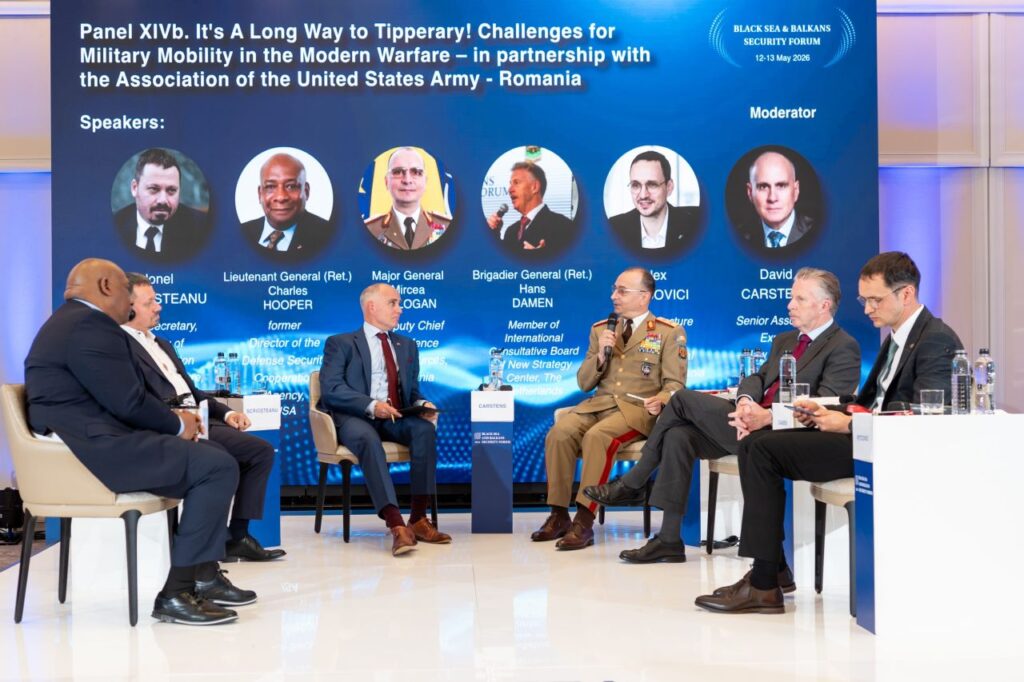
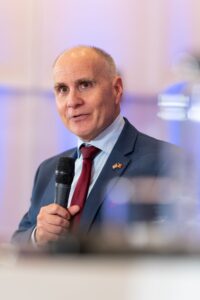
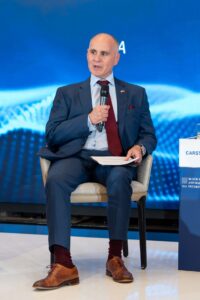
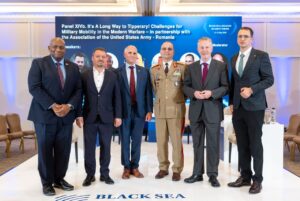
Carstens Consulting Global was honored to participate this week in the Black Sea and Balkans Security Forum in Bucharest, organized by the New Strategy Center. Our CEO and Founder, David Carstens, moderated a panel titled “It’s A Long Way to Tipperary! Challenges for Military Mobility in Modern Warfare,” held in partnership with the AUSA Prince Cuza Chapter – Bucharest.
A Forum That Matters
The Black Sea and Balkans Security Forum has become one of the most consequential annual gatherings for strategic dialogue on Europe’s south-eastern flank. It convenes senior military leaders, government officials, scholars, and industry partners from across NATO and allied states to address the security architecture of a region that has — since February 2022 — moved decisively from the periphery to the centre of Euro-Atlantic concern.
The Black Sea is no longer a contained theatre. It is a contested space where energy infrastructure, maritime trade, grain corridors, and military logistics intersect, and where the boundary between civilian and military assets has been deliberately blurred by Russia’s war on Ukraine. Convening the right voices to make sense of that complexity is precisely the kind of work the region needs more of, and the New Strategy Center has built the Forum into a venue equal to the task.
The Panel: Military Mobility in Modern Warfare
The panel brought together a remarkable group of practitioners:
- LTG (ret.) Charles W. Hooper
- Maj Gen Mircea Gologan
- Brig Gen (ret.) Hans Damen
- Ionel Scrioșteanu, Romanian Ministry of Transport and Infrastructure
- Alexandru Petcovici, Infrastructure Director, Proger Global Network
The conversation moved quickly past abstract principles and into the operational realities exposed by the war in Ukraine: that civilian infrastructure and traditional logistics systems are now legitimate targets, that supply chains can no longer be treated as a quiet rear-area problem, and that the speed at which NATO can move forces, materiel, and fuel across allied territory is now a defining variable of deterrence.
Three Themes Worth Carrying Forward
First, infrastructure must be built to military standards from the outset. The era in which dual-use was an afterthought — a nice-to-have layered onto roads, bridges, ports, and rail networks designed for commercial throughput — is over. The bridges that have to carry a main battle tank are not the bridges built for a delivery truck. Modernisation at this scale is expensive, slow, and politically demanding, which is precisely why it has to begin now.
Second, logistics corridors are alliance assets, not national ones. A NATO formation moving from Western Europe to the Black Sea passes through many jurisdictions, each with its own customs procedures, traffic regulations, host-nation support arrangements, and political sensitivities. Smoothing these seams is a diplomatic exercise as much as an engineering one. The work the European Union and NATO have begun on military mobility deserves acceleration, not incremental treatment.
Third, Romania is doing more than is widely recognised. Investments along the north–south axis, the development of dual-use transport infrastructure, and the integration of energy and logistics planning have positioned Romania as one of the most forward-leaning frontline states. There is more to do, and faster — but the trajectory is the right one, and partners across the Alliance should take note.
Why It Matters for the Alliance
The central message of the panel was simple and worth restating: the security of NATO’s Eastern Flank will increasingly depend on the Alliance’s capacity to build resilient infrastructure, integrated logistics, and rapid military mobility across the entire Euro-Atlantic space. None of those three can be delivered by any one nation acting alone. All of them depend on sustained political will, predictable funding, and the kind of patient, technical cooperation that does not always make headlines — but which determines whether deterrence holds when it is tested.
We are grateful to the New Strategy Center and, as representatives of AUSA Prince Cuza Chapter, we applaud their continued leadership in convening the conversations that this moment requires.